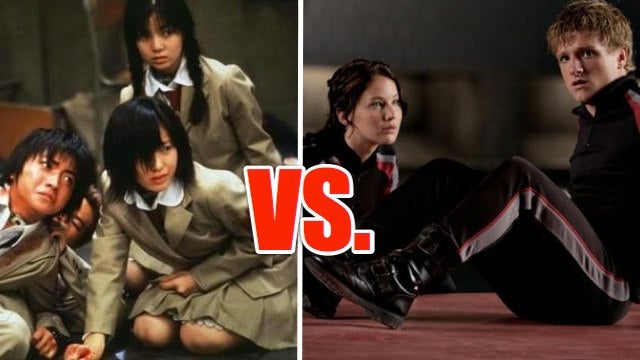
Elements of Camp in Battle Royale and The Hunger Games


Although the plot structures of Battle Royale and The Hunger Games parallel quite similarly, The way in which the messages and stories are presented are quite different. In Battle Royale (2000) there are elements of intentional-camp that serve to break stereotypes of gender role in the slasher teen genre. In The Hunger Games (2012) there are elements of unintentional-camp that serve to engage the younger audience, but are seen as comical to a maturer audience.
In looking at the cinematography of Battle Royale we notice that the camera does little to hide any bloodshed within the film. The viewer clearly sees limbs being cut and bodies being riddled with bullets. Whereas, in The Hunger Games, the camera starts to shake violently when fight scenes unfold, censoring a large portion of the action. This shakiness of the camera engages the audience to feel like they’re in on the action, but to a mature viewer this technique seems cheesy because it shows that the action wasn’t choreographed well and  serves to censor any gruesome violence. You can see the difference in camera movement through the links provided here:
               https://www.youtube.com/watch?v=zJo3CZfJ8Yo,  
               https://www.youtube.com/watch?v=7_NmE9gHuLM.
In Battle Royale the film breaks stereotypes of gender roles in slasher teen films and stereotypes of Japanese women. If we look at one of the girls in Battle Royale we’ll notice that Chigusa trains for some kind of marathon. It’s obvious to the viewer that this character acts abnormal because she seems to have no care of her inevitable death (all characters have timed-bombs strapped to their necks). She runs around in the arena in an all yellow jumpsuit as if enticing her enemies to come fight her. She is later approached by a boy who tries to make sexual congress with her. Chigusa is barely scratched on the face by the boy which inflicts her to stab him multiple times in the groin. There are other female characters that take on roles of confident and independent individuals. I believe the director was trying to demonstrate a more independent and self-thinking generation to Japan. The confident female characters in Battle Royale break the stereotype that all Japanese women are polite, sweet, and dependent on others. These dominant female characters also break into every social circle by seducing boys or befriending lonely classmates, which breaks another stereotype that Japanese women have social inabilities. The film also breaks the the stereotypes of gender roles in teenage slasher films by showing the female as the murderer rather than the victim.
  •  Tristan Vranizan
     Linked Articles:

Is The Hunger Games a Copy of Battle Royale?


There is an ongoing claim, having sparked from the screening and publication of The Hunger Games, that author Suzanne Collins had copied her storyline from another novel. The storyline is thought to have been copied from a Japanese bestselling novel called Battle Royale (1999), which conceived two films (Battle Royale [2000], Battle Royale II Requiem [2003]) and a series of manga books. The reason for this claim is because both The Hunger Games and Battle Royale depict a dystopian society that forces revolutionaries to kill each other in a type of arena game show. Suzanne Collins had publicly stated to the New York Times Magazine that she had never heard of BR before submitting her first draft. “I had never heard of that book or that author until my book was turned in. At that point, it was mentioned to me, and I asked my editor if I should read it. He said: ‘No, I don’t want that world in your head. Just continue with what you’re doing.” Some say it’s impossible for Collins to have not come across BR during her research, but some say there was enough resources for Collins to devise her own story. In comparing the films The Hunger Games (2012) and Battle Royale (2000) there are parallelling elements which may give suspicion to Collin’s credibility as an author.
In the film of Battle Royal the younger generation has become rebellious boycotting schools, attacking teachers, and disrespecting adults. Unemployment rises, so the “Millennium Educational Reform Act” is initiated (also named the BR Act). The BR Act randomly chooses a high school class to be taken to a deserted island in which the students are given weapons to kill each other until one victor is left to be the only survivor. This act is to intimidate the new generation into being compliant with the social order. The film blatantly displays the student's hacking and shooting away at each other with blood spraying from limbs and carcasses being thrown about. It is a gory film to say the least. Aside from murder being a prominent theme of the film, crushes and relationships seem to dominate the film as much as murder does. As the students fight for their survival three protagonists find a way out of the game and escape with their lives through efforts made by other students.
The Hunger Games is introduced with text giving a vague description of what’s to come of the film, “In penance for their uprising, each district shall offer up a male and female between the ages of 12 and 18 at a public “reaping.” These tributes shall be delivered to the custody of the capitol. And then transferred to a public arena where they will fight to the death, until a lone victor remains.” HG follows the story of a young woman, named Katniss, who lives under the rule of a much higher and sophisticated society. Katniss volunteers in replacement of her younger and vulnerable sister to partake in the killing game show. For the first half of the film Katniss spends time training, impressing sponsors, and preparing for the inevitable battle. Katniss spends most of her time alone avoiding alliances with others and succeeds in the game with the help of sponsors and her ability to hunt.
Both of these films demonstrate a dystopian society that punishes a kind of people who’ve at some point retaliated against a high power. Oddly both societies chose to pick teens as their contestants for their annual battle games, but the method in choosing their contestants are different. In BR a high school class is chosen at random (without sympathy for intelligence) and in HG one male and female are chosen from various districts. Although, similarly both societies used a lottery system to choose their victims. As for the actual battles (both taken place in a forested environment) we’ll notice a number of similarities in which the contestants camouflage themselves in their environment, commit suicide, form alliances with other contestants, and betray one another. Both battles are monitored by a team of people in which one man controls the operation. There are a number of similarities in the stories of the films, but the styles and messages of each film are quite different.
Battle Royale seems to focus mainly on the gore and the intensity of the character. Within the first half hour of the film ten people are already brutally murdered. The cinematography is relaxed and doesn’t seem to leave out any trace of action. As for the Hunger Games the film tends to focus mainly on Katniss for probably 80% of the film. The pace of the film is a lot slower and calmer than BR. But when battle ensues the camera shakes violently, seemingly to censor the gore that takes place, which makes sense because the film was intended for a larger general audience.
Although both films share surprisingly similar stories I believe Suzanne Collins did not imitate BR because there are numerous stories depicting arena style battles in human history. For example, there were the Roman gladiator games that lasted for over a thousand years and there are classical Greek myths about arena battles. A part of me still thinks Collins did steal some ideas from BR because it’s very hard to be original and copyright infringement is such a prevalent thing in motion pictures.
- Tristan Vranizan
Linked Articles:
1) http://io9.com/5888124/did-the-hunger-games-really-rip-off-battle-royale
2) http://www.nytimes.com/2011/04/10/magazine/mag-10collins-t.html

The Thing (1982) vs. The Thing (2011)


            After watching the 2011 prequel to John Carpenter’s The Thing, I was hit with a sad sense of disappointment in what initially appeared to be a very promising film. The original is one of my favorite horror films, and it seemed like prequel to The Thing would have the same reverence for the isolated, frigid, and overwhelming paranoia that defined it. How can two films share the same unsettling monster, take place in the same remote landscape, and reference one another, but be so dissimilar? It seems like the prequel forgot what makes the original unique from the barrage of forgettable, formulaic horror flicks that have come and gone: real scares come from people, not monsters. Although The Thing’s monster is horrific, it’s definitely not horrifying. The real horror is that the crew of an utterly remote research station in an unforgiving artic environment have no chance of survival unless they work together, even though any one of them could be a hostile alien imitation. The prequel tosses aside this paranoia in favor of upping the ghoulishness of the monster, as if that was what made audiences squirm with suspense throughout the 1982 film.
            Although the monster is essential to both films, the frequency and circumstance of its appearances differ greatly. This speaks to the conceptual difference between the prequel and the original, and illustrates pretty clearly why one works and one doesn’t.  In the John Carpenter version, the alien’s appearances aren’t even remotely subtle: they’re marked by tentacles busting through flesh, body parts turning into teeth-lined mouths, and blood spraying everywhere. However, the key to understanding why the audience doesn’t get bored with this lies in when we get to see these gory spectacles unfold. Aside from just a few instances, the alien only appears in the 1988 film when it’s threatened. It assimilates and kills the dogs that bark at it, it devours the doctor who is about to shock it, and it bursts out of Palmer’s body when it is exposed. This survival instinct gives the creature an added element of intelligence and depth, which makes it more unsettling. More importantly, it puts the emphasis on the team of researchers to discover who is an imposter, rather than having them simply run around and try to survive a malicious monster as it tries to eat them. The latter is, unfortunately, what the 2011 version of the film is guilty of. The monster attacks simply because its a monster – mutating from human to alien at random, impaling unlucky scientists as it chases the protagonist down a hallway, and inexplicably destroying a helicopter that could have brought it in contact with more humans. As Steve Newton writes, the film “didn't even bother trying to conjure any of [the original’s] slow-burning suspense or claustrophobic vibe.” [1] With only “boo” scares and no dramatic depth, the movie quickly becomes mundane and forgettable.
Monster reveals are tricky, because they risk removing the element of scariness from the monster. The 1982 version narrowly avoids this with its reveals (although it comes close at the end, when a large alien creature bursts out of the ice wiggling its tentacles aimlessly) by giving them motivation, and especially by using context to shift more of the monster’s dramatic weight to the scenes without any monster at all. The 2011 version puts its focus on how grotesque the aliens transformations can be, and seems to forget about the whether or not the characters can outwit it.
 In Will Leitch’s review of the prequel, he writes “There's just no sense of dread in this "Thing," no notion that these people are truly at the edge of the world, with nowhere to escape and no one to trust.” [2] The environment is cold, but it doesn’t feel nearly as desolate or dangerous as it does in John Carpenter’s version, where the wind moans relentlessly and the walls of the camp seem perpetually on the brink of collapse. More importantly, although our characters are pitted against an evil creature, they are not pitted against each other.
-       Daniel Washington
Linked Articles:
1) http://earofnewt.com/2013/12/17/horror-review-the-thing/
2) https://www.yahoo.com/movies/bp/review-thing-155757947.html